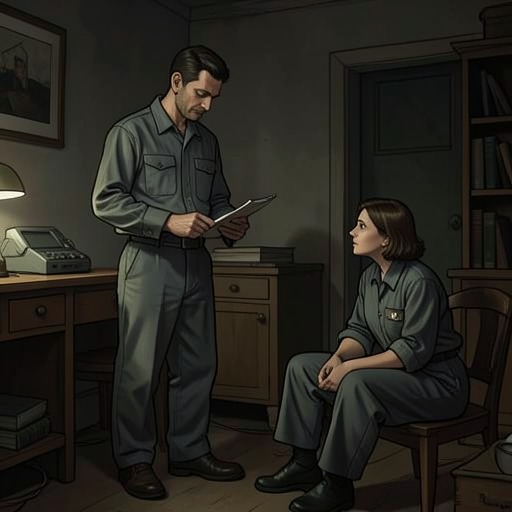
Amanda
Lessons in ChemistryAmanda is Walter Pine’s daughter despite having no biological relationship to him, a fact that comes to light through a paternity test but does not alter their bond. Her story places the novel’s contrast between biological descent and lived kinship in ordinary family life: Walter loves her as his child, while the school’s family-tree assignment threatens to make the missing biological link seem more important than the relationship they share.
Identity and parentage
Amanda is the daughter of Walter Pine and his former wife. Walter had heard his ex-wife insist that he was not Amanda’s biological father, but he initially treated the claim as a cruel attempt to hurt him. Their lack of resemblance did not persuade him otherwise; in his experience of holding and caring for Amanda, he felt certain of a profound connection. The uncertainty remained, however, and eventually he gave a blood sample for paternity testing.
The result, delivered five days later, showed that Walter and Amanda were biologically unrelated. He had learned this only three weeks before telling Elizabeth Zott about it. His first response was not the devastation or sense of betrayal he had imagined he might feel. The result did not change his understanding of who Amanda was to him: she was his daughter, and he loved her wholeheartedly. The revelation makes biological non-parentage a fact about their origins, not a reversal of their family relationship.
Walter’s fatherhood in daily life
Walter says that he had never planned to become a parent, yet he has become a devoted father. His account links that change to the unpredictability of life: family arrived not as the outcome of a plan but as a relationship he embraced. His certainty about Amanda is especially striking beside the paternity result. A test can identify the absence of a genetic tie; it cannot undo years of attachment or dictate the meaning Walter gives to being her father.
That commitment also appears in small domestic details. When Walter has not eaten, Elizabeth gives him a baking dish of spinach casserole and instructions for heating it. Walter objects that Amanda hates spinach. The exchange offers a brief, practical glimpse of how closely his attention is organized around his daughter’s preferences, even while he is unwell himself. Amanda is not present in the exchange, but her likes and dislikes are familiar enough to shape what Walter says he can bring home.
The family-tree assignment
Amanda’s school assignment makes the difference between family and biology newly difficult for Walter. It calls for a current family photograph including a mother who is no longer in the picture, and it asks the child to celebrate the biological relationship between herself and Walter—a relationship he now knows does not exist. He intends to tell Amanda the truth, reasoning that she has a right to know, but postpones the conversation while waiting for the right moment. His joke that the moment might be her fortieth birthday exposes the strain between his recognition of that responsibility and his reluctance to face it.
The assignment’s demand for a photograph and a biological connection turns an ordinary classroom exercise into a test of which forms of kinship institutions can recognize. For Walter, the problem is not that his love for Amanda has weakened; it is that a worksheet makes biological descent appear to be the defining evidence of family. The story lets the gap stand plainly: Walter knows they are strangers in genetic terms, yet he remains her father in the relationship that matters to him.
Relationships and belonging
Amanda’s affection extends beyond Walter. When she calls for Harriet Sloane to come and play, Harriet first suggests that Amanda and Madeline Zott build a fort and promises to join them shortly. Walter notices Amanda’s fondness for Harriet. He has also become increasingly attached to Harriet through his visits to the Zott home, though he keeps his own feelings to himself. Amanda’s invitation thus belongs to a wider pattern of connection around the children, but the scene does not suggest that her bond with Harriet displaces Walter’s place as her father.
The novel’s broader family-tree thread likewise resists treating lineage as a complete map of belonging. Madeline identifies Avery Parker, rather than Avery’s lawyer, as family on the tree she has made. That moment is not Amanda’s own decision, but it echoes the distinction her circumstances make central: family can include people whose place is established through care, recognition, and connection rather than a simple biological chart. Amanda’s significance lies in how decisively Walter lives that distinction. The test exposes a genetic fact; his continued devotion shows that the fact cannot define the whole family.